| Filter cleaning | every 2 months (CMHC) |
| Core cleaning | once a year (Health Canada) |
| DIY-able? | Partly: filters yes, core and ductwork need a pro |
| Safe to wait? | Clogged filters can shut the unit down |
| Price | Free quote |
Key takeaways
- HRV filters should be cleaned every 2 months. The heat exchange core and condensate drain need attention at least once a year.
- Skipping filter cleaning reduces airflow, can trigger the unit to shut down, and lets dust build up inside the core where you cannot easily reach it.
- A professional HRV cleaning goes beyond what most homeowners can access: the internal fans, the drain pan, and the ductwork that connects the HRV to the rest of the house.
A heat recovery ventilator brings fresh outdoor air into your home while pushing stale indoor air out. It uses the outgoing air’s warmth to preheat the incoming supply so you are not dumping heated air straight outside. Most newer BC homes have one, and so do many older homes that went through energy retrofits. On the damp coast, where winters run long and summer wildfire smoke settles into neighbourhoods, the HRV handles a heavy load of air and collects whatever comes with it.
What the HRV does (and why it gets dirty)
The HRV is separate from your furnace, though the two often share ductwork. It has its own fans, its own heat exchange core, its own filters and its own condensate drain. Air passes through all of those components every time the unit runs.
Canadians spend roughly 90% of their time indoors, according to NADCA. The HRV is there to maintain your indoor air quality, but it can only do that job if air can actually move through it. Dust, pet hair, pollen and whatever the outdoor intake pulls in all land on the filters first. What gets past the filters ends up on the core.
The filters: what you clean every two months
CMHC recommends cleaning or replacing HRV filters every 2 months. Health Canada’s guidance says at least every second month. The two sources agree: this is the single most frequent maintenance task on the unit.
Most HRV filters are washable. You pull them out, vacuum off the loose dust, wash them with mild soap and water, and let them dry before sliding them back in. The whole job takes a few minutes.
If you skip this step, the filters restrict airflow. On units with an airflow switch, a clogged filter will shut the HRV down entirely. And every hour the unit runs with restricted flow, more particles bypass the filter and settle on the heat exchange core.
Pro tip: Set a reminder for the first of every other month. Pull the filters, hold them up to a window. If light barely passes through, they are overdue. This two-minute check keeps the HRV running and prevents a bigger cleaning job later.
The heat exchange core: the annual job
Health Canada recommends cleaning the heat exchange core and the condensate drain and pan annually. The core is the part of the HRV where outgoing and incoming air streams pass close together so heat transfers between them without the two streams mixing. Dust on the core surfaces reduces that heat transfer and chokes airflow.
Cleaning the core means removing it from the unit, vacuuming the surfaces and washing it with warm water and mild soap. CMHC recommends letting it dry fully before reinstalling. While the core is out, check the condensate drain: pour warm water into each drain pan and watch that it flows freely.
This is where most homeowners start to feel less comfortable. The core is bulky, it has a specific orientation it needs to go back in, and the condensate drain may not be straightforward to access. A drain that is not flowing properly means moisture is building up inside the unit.
Heads-up: Reinstalling the core upside down reverses the airflow paths and the unit cannot recover heat properly. If you are not sure which way is up, mark the top with tape before you pull it out, or leave this to a pro.
Signs your HRV needs attention
1. Condensation on windows
If your windows fog up in winter and they did not used to, the HRV may not be moving enough air. A dirty filter or a clogged core reduces airflow to the point where moisture builds up indoors instead of being exhausted.
2. A stale or musty smell indoors
The HRV brings fresh air in. If you notice a damp or off smell when the unit is running, the filters, core, or drain pan may be harbouring mould or bacteria. In Metro Vancouver’s damp climate, this happens when the condensate drain gets blocked.
3. The unit runs but the house still feels stuffy
Check the filters first. If those are clean, the issue may be deeper: duct connections that have loosened, a core that is clogged with debris, or fans that are coated in dust and no longer moving their rated volume of air.
What a professional cleaning adds
You can handle the filters. You may be able to manage the core. The rest of the HRV system is harder to reach and harder to assess on your own.
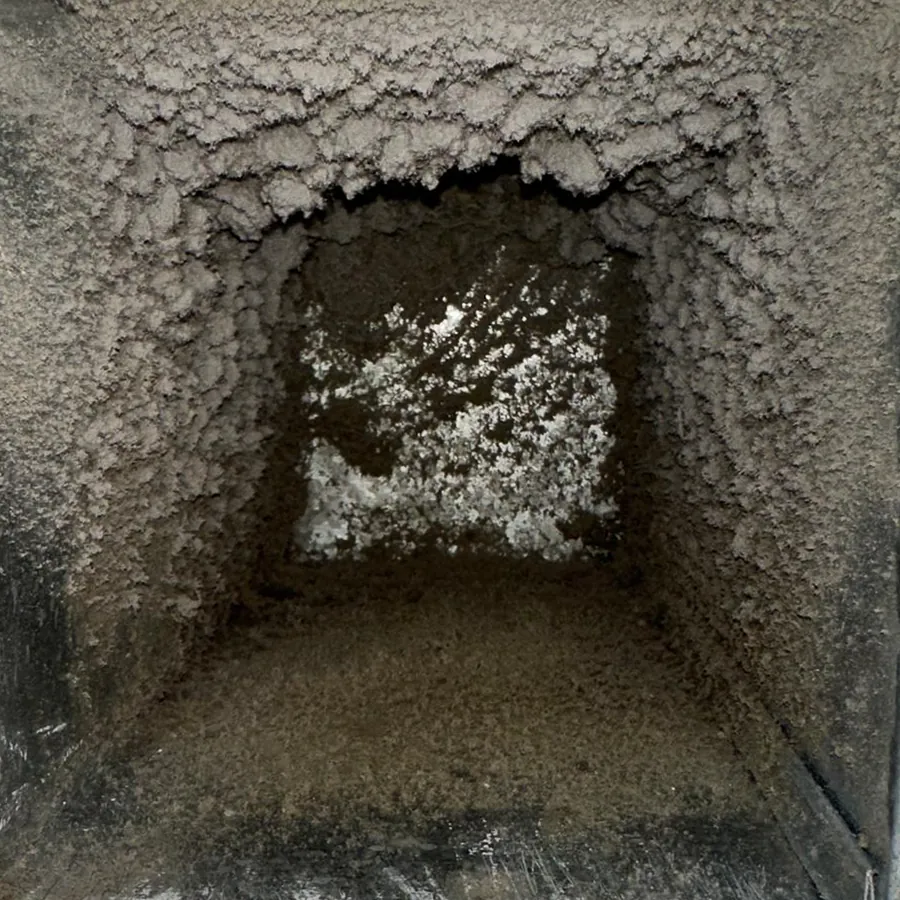
When we clean an HRV, we clean the full unit and the ductwork connected to it. That includes the heat exchange core, both fans, the drain pan, the condensate drain, and the supply and exhaust ductwork running to and from the unit. We use HEPA-filtered negative-air equipment and compressed-air agitation, the same source-removal method we use on furnace and duct cleaning jobs.
CMHC recommends checking the ductwork leading to and from your HRV at least once a year. The supply and exhaust runs that connect the HRV to the outside and to your indoor air system collect dust, construction debris and moisture just like the rest of your ductwork. Your indoor air recirculates 5 to 7 times per day on average, and everything in that cycle passes through the HRV if the unit is running.
After cleaning, we can apply Benefect Decon 30, a Health Canada approved, plant-based disinfectant, through the system if mould or odour is a concern. Before we close the system, we invite you to see the final cleaning of the main trunk so you can see the condition of the ductwork yourself.
Get a free quote
If your HRV filters are loading up faster than you can keep up with, or the core and drain have not been touched since the unit went in, get a free quote and we will walk you through what the job covers for your home. We are NADCA certified with 10+ years of experience cleaning homes across Metro Vancouver and the Fraser Valley.
For more on how furnace and duct cleaning fits alongside HRV service, see our guide on furnace cleaning vs duct cleaning.
Where we do this work
Vancouver, North Vancouver, West Vancouver, Burnaby, Richmond, Surrey, Coquitlam, Port Coquitlam, Port Moody, New Westminster, Delta, Langley, White Rock, Maple Ridge, Pitt Meadows, Abbotsford.