| What is it | Written record of cleaning scope, methods, and verified results |
| Who needs one | Building owners, property managers, strata councils |
| Industry standard | NADCA ACR (The NADCA Standard) |
| Verification methods | Visual inspection, Surface Comparison Test, or NADCA Vacuum Test |
| What we deliver | Certificate of Completion with before-and-after photo report |
| Price | Custom quote |
Key takeaways
- A thorough cleaning report documents what was cleaned, how cleanliness was verified, and what needs follow-up. It becomes your evidence when tenants, insurers, or auditors ask questions.
- NADCA’s ACR standard and general specification outline what a commercial cleaning project should produce: photo records, cleanliness verification results, and notes on any damage found.
- If your contractor hands back an invoice and nothing else, you are missing the documentation that protects your building investment.
Air in a commercial building recirculates through the HVAC system 5 to 7 times per day on average. A cleaning report documents the condition of everything that air passes through: ductwork, air handling units, coils, grilles, and exhaust runs. In BC, where coastal humidity promotes mould and summer wildfire smoke pushes extra particulate into supply ducts, that documentation carries real weight with insurers, strata councils, and building auditors.
What a complete report covers
NADCA’s commercial cleaning checklist calls for verification of cleanliness through inspection and/or testing in accordance with NADCA Standards, plus a Post-project Report. Here is what that looks like in practice.
1. Scope of work summary
The report should state which HVAC components were cleaned: supply ducts, return ducts, exhaust runs, air handling units (AHU), coils, diffusers, and grilles. It should also note which floors, wings, or zones were included. A vague “cleaned the ducts” line does not cut it. You want the scope detailed enough that you can compare it against the original quote and confirm the full system was addressed.
2. Before-and-after photo documentation
Photos of duct interiors, coil surfaces, and AHU components taken before and after the cleaning. These images are your most practical proof that contaminants were removed. The photos should be labelled with the location and component name so you can match each pair back to the scope of work.
3. Cleanliness verification results
The report should describe how the contractor confirmed the system is clean. NADCA’s ACR standard defines two methods: the Surface Comparison Test, done visually on site against a reference standard, and the NADCA Vacuum Test, a lab-based analysis of surface samples. At minimum, the contractor should note that a visual inspection confirmed all accessible duct surfaces are free of visible debris. If lab testing was performed, a copy of the results belongs in the report.
4. Access panel and service opening locations
When the crew cuts new service openings into ductwork during cleaning, those openings need to be sealed to SMACNA and UL closure standards, marked on the exterior of the duct, and their locations documented. This matters for future maintenance. The next contractor who works on your system needs to know where to access it without cutting new holes.
5. Deficiencies and damage found
Any damage discovered during the cleaning should be documented: corroded duct sections, disconnected joints, failed insulation, broken dampers. The same goes for conditions that fall outside the cleaning scope but affect indoor air quality, like standing water in drain pans or visible mould. A good report flags these so you can address them on your own timeline rather than discovering them during the next cleaning cycle.
6. Equipment and methods used
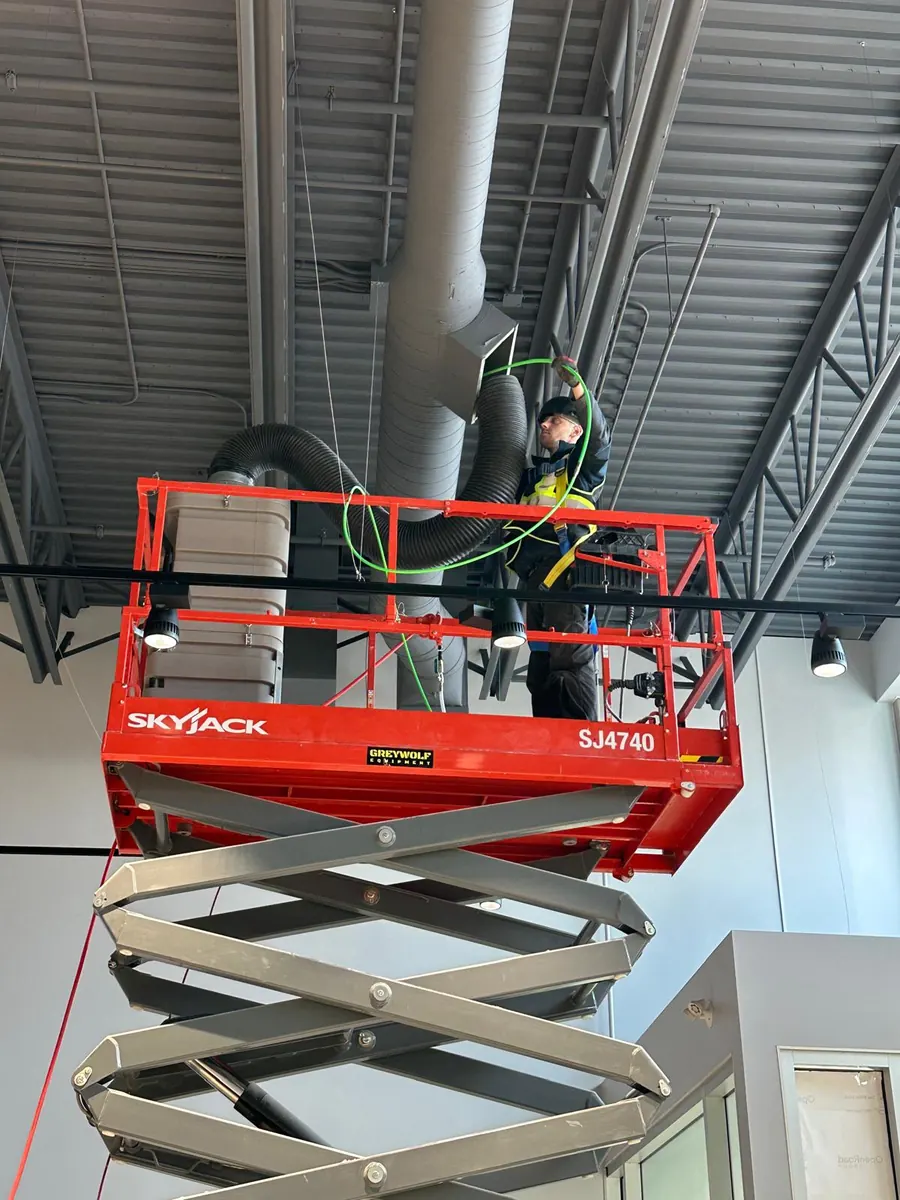
What vacuum equipment was deployed (HEPA-filtered negative-air machines, compressed-air agitation, mechanical brushes). Whether a Health Canada registered disinfectant was applied after source-removal cleaning. Which coil cleaners or chemical agents were used. This information matters for your maintenance records and for demonstrating compliance if your building serves a regulated environment such as healthcare or food service.
Pro tip: Before the job starts, ask your contractor for a sample post-project report. A company that builds reporting into every job will have one ready. If they cannot show you a sample, that tells you how much documentation you will get at the end.

Why this documentation matters
Your building insurer may ask for proof of ventilation maintenance as part of a claim or renewal. A tenant filing an indoor air quality complaint will want to know when the system was last serviced and what was done. If you manage strata or institutional properties in BC, WorkSafeBC’s requirements for acceptable indoor air quality mean you need to show that preventive maintenance is happening.
The report also feeds your long-term maintenance picture. When you can compare this year’s photos and verification results against previous reports, you see how your system degrades over time and where to focus resources next.
Heads-up: A contractor who cleans your system but produces no written report leaves you with nothing when an insurer, regulator, or tenant asks what was done. The cleaning may have been thorough, but you have no way to prove it.
What we include
We are NADCA certified and deliver a Certificate of Completion and a before-and-after photo report with every commercial cleaning we do. The report covers the full scope of work, verification results, any deficiencies found, and recommendations for follow-up. We carry $5M liability insurance, are WorkSafeBC compliant, and have 10+ years of experience with commercial HVAC systems across BC, including work at Surrey Memorial Hospital, Richmond Hospital, and UBC.
If you manage a commercial building and want to see what a proper cleaning report looks like, get a free quote and we will walk you through the scope and documentation before any work begins.
Where we do this work
We clean commercial HVAC systems across BC: Vancouver, Burnaby, Surrey, Richmond, Coquitlam, Port Coquitlam, Port Moody, New Westminster, North Vancouver, West Vancouver, Delta, Langley, White Rock, Maple Ridge, Pitt Meadows, Mission, Abbotsford, Chilliwack, Squamish, Whistler, Kamloops, Kelowna, Nanaimo, and Victoria. We also serve commercial buildings in Alberta.
For more on scheduling and what commercial cleaning involves, see our guide to commercial duct cleaning in BC.