| Inspection interval | annually (NADCA commercial checklist) |
| BC requirement | WorkSafeBC OHS Section 4.78: preventive maintenance on ventilation |
| Containment standard | HEPA filtration with 99.97% efficiency at 0.3 micron |
| Cleaning standard | NADCA ACR (source removal with cleanliness verification) |
| Report included | Certificate of Completion with before-and-after photos |
| Price | Get a custom quote |
Key takeaways
- WorkSafeBC Section 4.78 requires a preventive maintenance program that includes cleaning air distribution systems, ducts and dampers when there is an indoor air quality deficiency.
- NADCA recommends inspecting AHUs, supply ducts, and return ducts annually for commercial buildings, with at least 10% of system components checked.
- Warehouses that handle dust, welding fumes, or volatile compounds load ductwork faster than typical offices, and the ventilation system recirculates that air 5 to 7 times per day.
- A proper warehouse ventilation clean covers the full system: ductwork, air handling units, coils, diffusers, grilles, and exhaust runs.
Warehouses move a lot of air. Makeup air units pull in outdoor air, supply ducts push conditioned air across the floor, and exhaust fans draw fumes and heat out. That air passes through the system 5 to 7 times per day, on average. Every pass deposits a thin layer of whatever is in the building: sawdust, metal particles, shipping dust, welding fumes, forklift exhaust, moisture from loading docks.
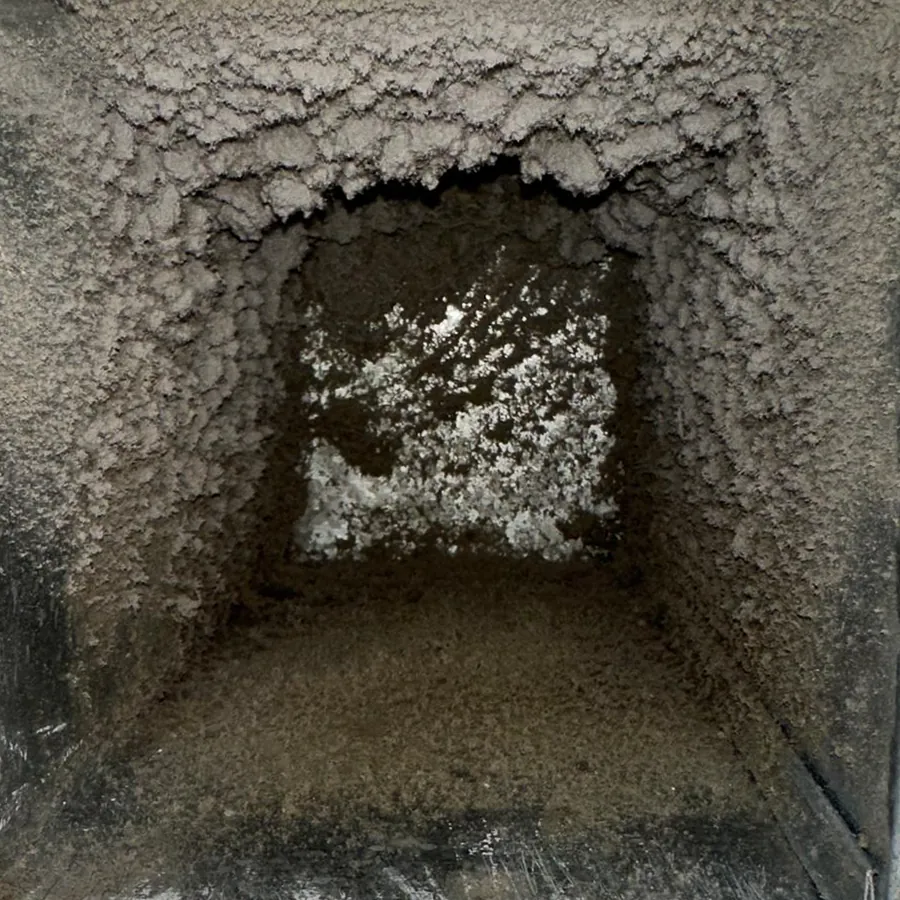
Over months, that buildup restricts airflow, loads the coils, and puts contaminants back into the breathing zone. In a BC warehouse, damp coastal air adds the risk of mould growth inside ductwork, especially in sections with condensation or standing water.
This article covers what warehouse ventilation cleaning involves, what WorkSafeBC expects, and how to plan the work around your operations.
Signs your warehouse ventilation needs cleaning
Visible dust on diffusers and grilles
If the supply diffusers or return grilles have a visible film of dust or debris, the ductwork behind them is worse. Dust on surfaces you can see means dust on surfaces you cannot.
Persistent odours
Stale or chemical smells that linger after the source is gone often point to contamination trapped in the ductwork or air handling unit. The system recirculates whatever is deposited inside it.
Rising energy costs with no other explanation
Coils coated in dust lose heat transfer efficiency. Fans work harder to push air through partially blocked ducts. If your utility bills are climbing and the equipment checks out mechanically, the problem may be inside the air distribution system.
Worker complaints about air quality
Staff reporting headaches, irritation, or respiratory discomfort is a signal. WorkSafeBC sets occupational exposure limits for airborne dust and fumes, and when ventilation systems are not maintained, contaminant levels in the breathing zone can climb. Under the OHS Regulation, the employer is required to investigate indoor air quality complaints (Section 4.79) and take corrective action.
What a warehouse ventilation clean covers
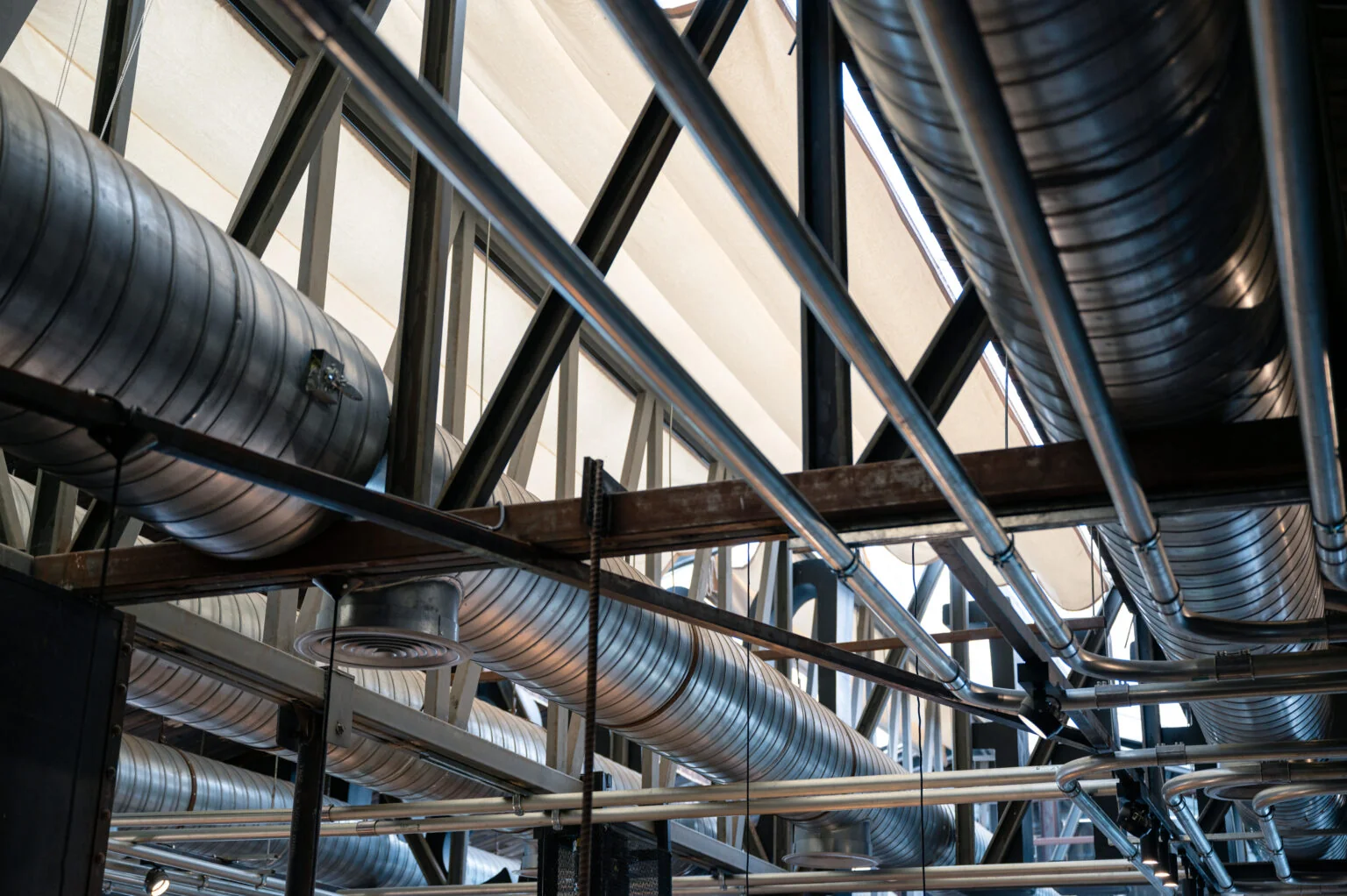
Warehouse HVAC systems are bigger and rougher than office systems. The ductwork runs longer, the air handling units are larger, and the contamination is heavier. Here is what a full-scope clean includes.
Ductwork (supply, return, exhaust)
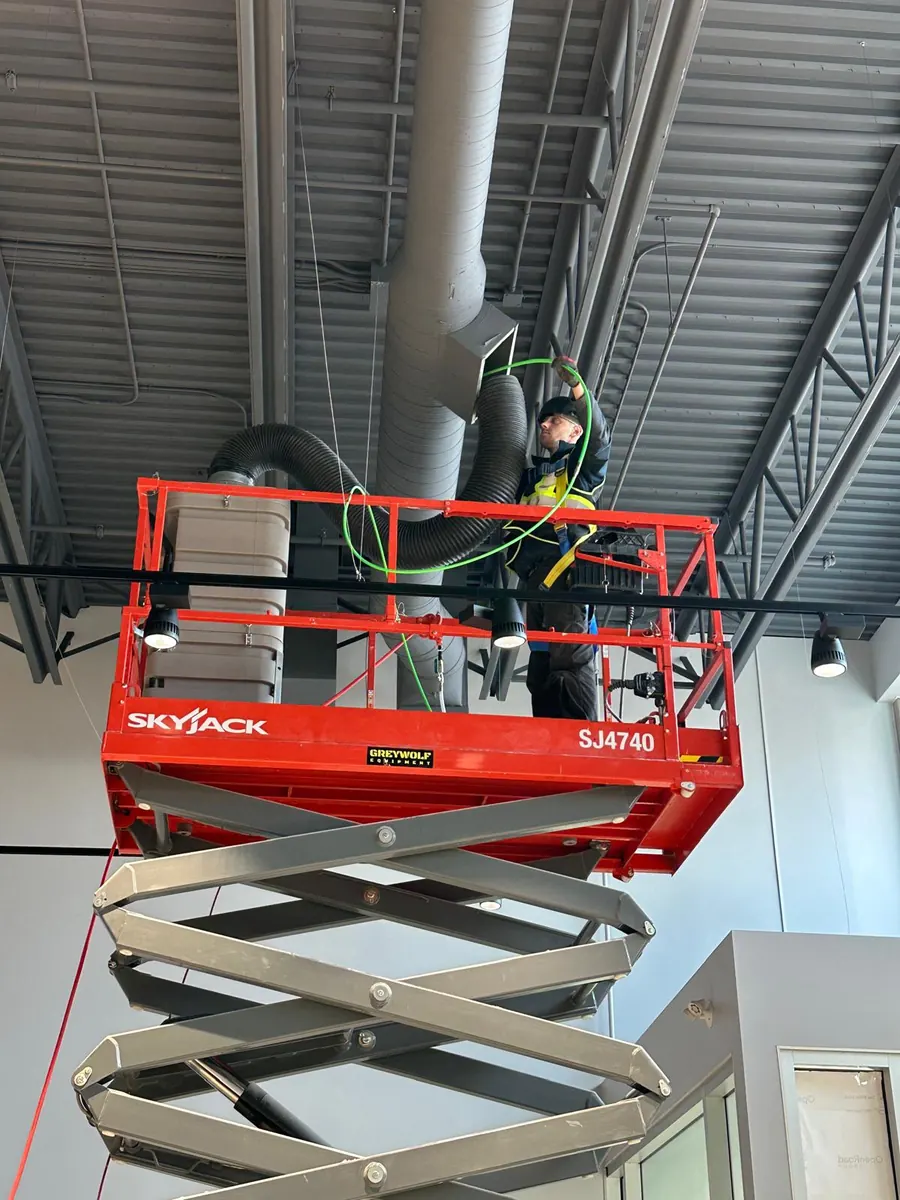
All accessible supply, return, and general exhaust ductwork is cleaned using HEPA-filtered negative-air vacuuming and compressed-air agitation to remove dust and debris. The system is placed under continuous negative pressure during cleaning so contaminants do not escape into the workspace.
Air handling units, makeup air units, and rooftop units
The air handling unit (AHU) is where most contamination collects. Internal surfaces, coils, condensate drain pans, drain lines, fan compartments, and dampers are all cleaned. NADCA’s commercial checklist requires annual inspection of these components. We cover AHU cleaning in detail in our article on what NADCA ACR covers for air handling units.
Coils, diffusers, grilles, and components
Heating and cooling coils are cleaned with compressed air, HEPA vacuum, and coil cleaner to restore heat transfer and airflow. Diffusers, return and exhaust grilles are power-wiped and air-washed. Removable components are taken down for cleaning before reinstallation.
Exhaust and makeup air systems
Warehouses often have dedicated exhaust fans for welding bays, paint booths, loading docks, or general ventilation. These systems and their associated ductwork are cleaned as part of the scope. We cover commercial exhaust and makeup air cleaning in a separate article.
WorkSafeBC Section 4.78 and your obligation
WorkSafeBC’s OHS Regulation Section 4.78 requires that the owner of the ventilation system must establish an effective preventive maintenance program for the ventilation system. That program must include:
- Inspections of ventilation system components including dampers, fans, belts, ductwork, diffusers, and control systems.
- The cleaning of air distribution systems, ducts and dampers when necessary to correct an indoor air quality deficiency.
- Repair or replacement of malfunctioning and consumable components like filters and belts.
The regulation does not prescribe a fixed cleaning schedule. It requires the program to exist and to act when deficiencies are found. For a warehouse generating dust or fumes, that threshold arrives faster than it does in a standard office building.
Your Certificate of Completion and before-and-after photo report from each cleaning becomes part of the compliance record. If a WorkSafeBC inspector asks about your ventilation maintenance, that documentation shows the program is active.
Pro tip: Before booking a full clean, ask your HVAC contractor to do a visual assessment of the ductwork and AHU internals. If dust, debris, or biological growth is visible, the system needs cleaning. That assessment sets the scope and avoids paying for work that is not needed yet.
How the cleaning works
The crew follows NADCA’s ACR standard (Assessment, Cleaning and Restoration of HVAC Systems). The primary method is source removal: contaminants are mechanically dislodged from duct surfaces and captured at the source, rather than pushed downstream.
Containment and negative pressure
Equipment used indoors has HEPA filtration with 99.97% collection efficiency at 0.3 micron particle size. The ductwork section being cleaned is kept under continuous negative air pressure so dust cannot migrate into occupied areas. This matters in a working warehouse where staff or product may be nearby.
Cleaning methods
The ACR standard covers source removal, ambient air cleaning, wet cleaning, power washing, and steam cleaning. Source removal is the default for ductwork. Coils and drain pans may require wet cleaning or chemical application. The method depends on the type of contamination.
Cleanliness verification
After cleaning, the NADCA Vacuum Test checks that the net weight of debris collected from the duct surface does not exceed 0.75 mg/100 cm2. The cleanliness inspection covers at least 10% of the HVAC system components. Results go into the project report.
Access
Existing service openings are used wherever possible. When new access panels are needed, they are built to SMACNA duct construction standards: mechanically fastened, sealed, re-openable, and marked on the duct exterior.
Heads-up: Putting off ventilation cleaning in a warehouse that generates airborne dust or fumes does not just affect air quality. Loaded coils and restricted ducts force the system to work harder, and that shows up on your energy bills every month until the system is cleaned.
Planning the work around your operations
Warehouse ventilation cleaning can be scheduled around shifts. The crew can work overnight, on weekends, or clean one zone at a time while the rest of the building stays operational. For large facilities, the project may run over multiple visits.
The scoping process starts with a site walkthrough. We look at the ductwork layout, the number and type of air handling units, the type of contamination, access points, and ceiling height. That walkthrough produces a written scope and schedule before any work begins.
AirCare Systems BC is NADCA certified and WorkSafeBC compliant, with $5M liability insurance and 10+ years of experience in commercial and industrial ventilation cleaning across BC and Alberta.
Get a custom quote for your warehouse.
Where we do this work
We clean warehouse and industrial ventilation systems across BC: Vancouver, Burnaby, Surrey, Richmond, Coquitlam, Port Coquitlam, Port Moody, New Westminster, North Vancouver, West Vancouver, Delta, Langley, White Rock, Maple Ridge, Pitt Meadows, Mission, Abbotsford, Chilliwack, Squamish, Whistler, Kamloops, Kelowna, Nanaimo, and Victoria. We also serve commercial facilities in Alberta. See our full commercial service areas for details.