| Access methods | Rope access, scissor lifts, scaffolding |
| Fall protection trigger | 3 m height (WorkSafeBC Part 11) |
| Written safety plan | Required above 7.5 m (WorkSafeBC) |
| Airflow gain from cleaning | 10 to 46% improvement in supply airflow (NADCA) |
| Price | Custom quote |
Key takeaways
- Ductwork above 3 m in warehouses, atriums and tall commercial buildings needs specialized access equipment and fall protection under WorkSafeBC Part 11.
- Rope access technicians in BC must hold IRATA or SPRAT certification and work on a two-rope system under WorkSafeBC Part 34.
- The cleaning itself follows NADCA ACR (the NADCA Standard) regardless of height. What changes is the access planning, safety coordination and equipment.
- AirCare is NADCA certified, WorkSafeBC compliant and carries $5M liability insurance for high-reach commercial work across BC.
High-reach duct cleaning is standard commercial HVAC cleaning done at height. It applies to any building where ductwork, diffusers or air handling equipment sits above roughly 3 m (10 ft): warehouse ceilings, retail atriums, hospital corridors with exposed mechanical systems, double-height lobbies. The ducts collect the same dust, debris and biological contaminants as any other ductwork. Getting a crew and equipment to the work face safely is what makes these jobs different. BC’s coastal climate adds moisture to the equation, and condensation on high metal ductwork can encourage mould growth that lower runs rarely see.
Why high ductwork still needs cleaning
Contaminants in a commercial HVAC system are re-circulated 5 to 7 times per day, on average. That air passes through every duct in the system, high or low. Dust, fibres and microbial growth accumulate on high duct surfaces the same way they do at floor level. The difference is nobody walks past and notices.
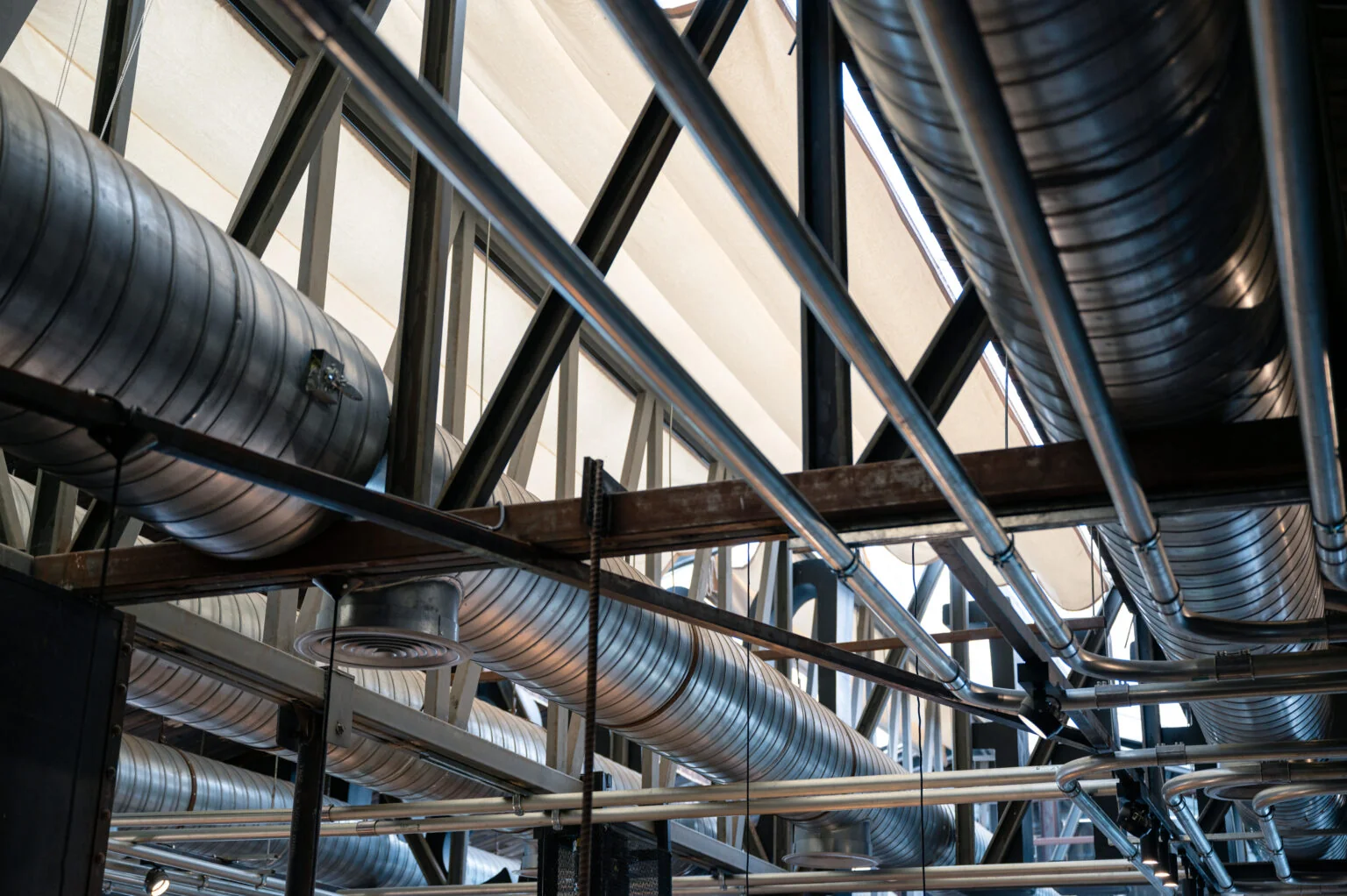
Buildings with tall open spaces often have long horizontal duct runs suspended from structural steel or roof deck. These collect settled particulate on top and biological growth inside, but they sit far enough above the floor that visible contamination goes unnoticed for years.
Signs your high ductwork needs attention
1. Visible dust on high diffusers or grilles
If you can see buildup on the registers from the floor, the ductwork behind them is worse.
2. Uneven airflow across the building
Partially blocked high runs can starve one zone while over-feeding another.
3. Musty or stale odours with no obvious ground-level source
Mould or standing moisture inside high ductwork can push odours into the occupied space every time the system cycles.
4. No record of a previous clean
If the maintenance file has no duct-cleaning entry, assume the system has never been cleaned.
Access methods for tall spaces
The right equipment depends on the building. Here is what we use and when each method fits.
| Method | Best for | Considerations |
|---|---|---|
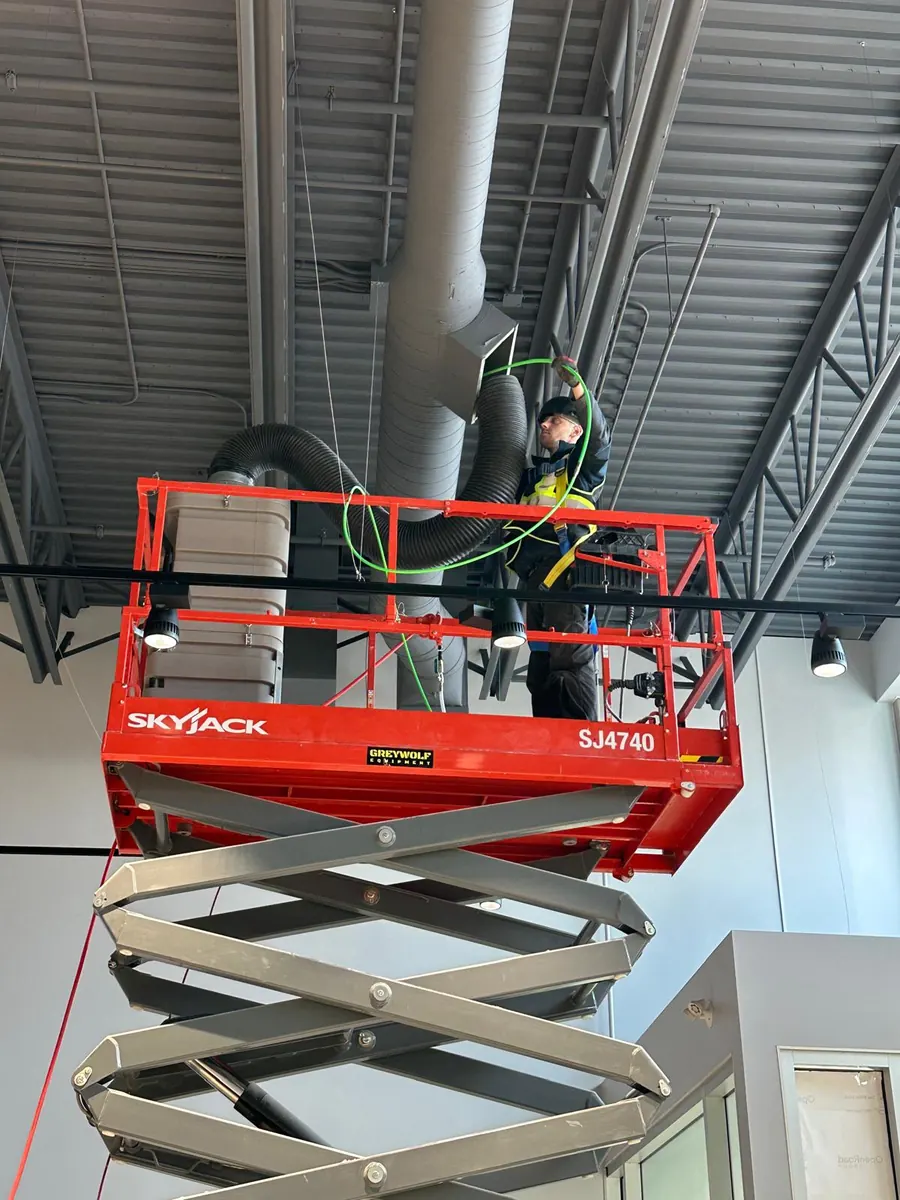
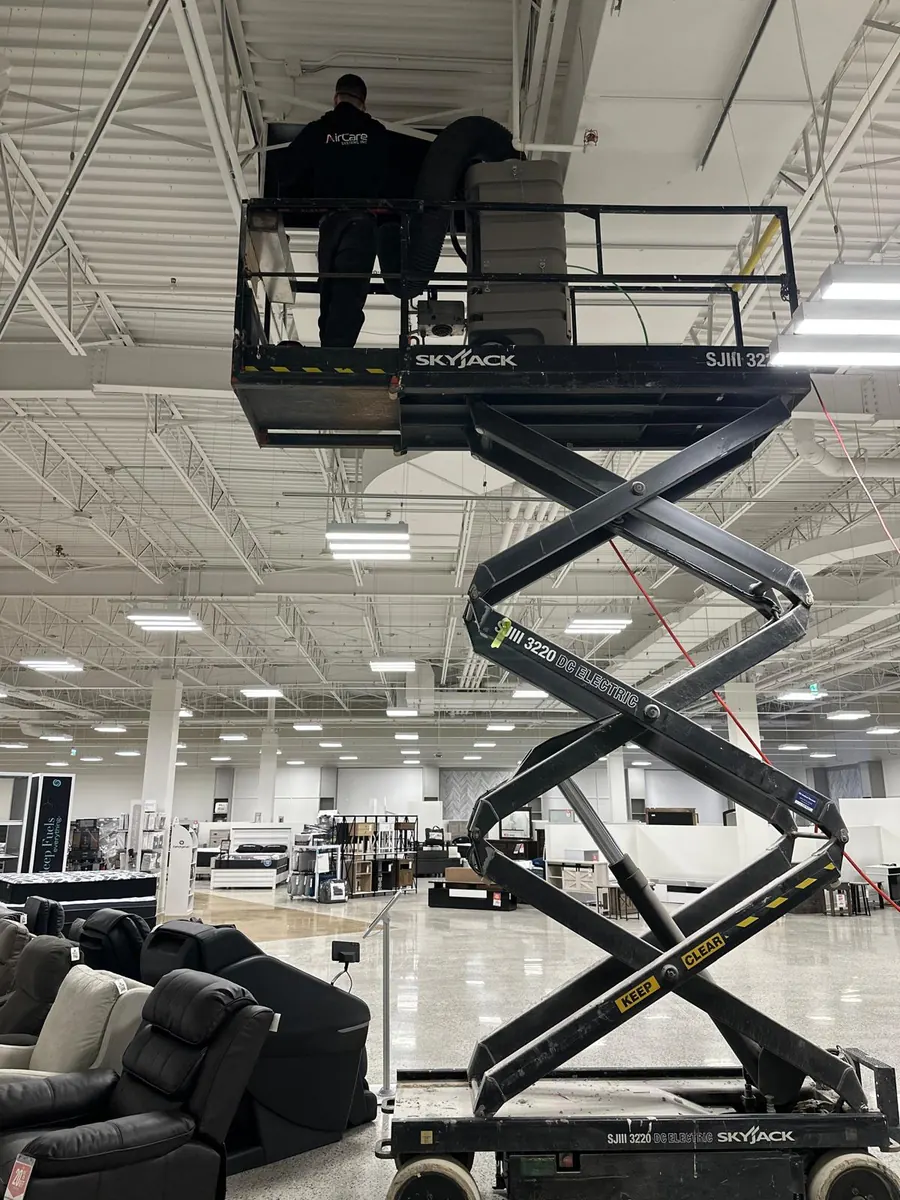
| Scissor lift | Open floors, warehouses, retail | Needs flat, load-bearing floor and doorways wide enough for the unit |
| Boom lift | Atriums, angled access, exterior ductwork | Requires clearance for boom swing; heavier than a scissor lift |
| Scaffolding | Tight or fixed areas, stairwells, ongoing access | Time-intensive setup; good for multi-day jobs |
| Rope access | Restricted spaces, structural steel, high ceilings with no lift path | IRATA/SPRAT certified technicians; smallest equipment footprint |
On some jobs we combine methods. A scissor lift might handle one wing of a warehouse while rope access covers a section above racking where the lift cannot fit.
WorkSafeBC requirements for high-reach HVAC work
Any contractor cleaning high ducts in BC must comply with the Occupational Health and Safety Regulation. Two parts matter most.
Part 11 (fall protection) requires fall protection at any work location where a fall of 3 m (10 ft) or more may occur. Above 7.5 m (25 ft), a written fall protection plan must be in place before work begins. The plan covers hazards, anchor points, equipment, rescue procedures and team roles.
Part 34 (rope access) adds requirements when technicians are suspended on ropes:
- Valid certification from IRATA (Industrial Rope Access Trade Association) or SPRAT (Society of Professional Rope Access Technicians).
- A two-rope system: a working line plus an independent backup line, each with its own anchor.
- A written rope access plan specific to the site.
- Full body harness meeting CSA or ANSI standards.
Pro tip: Before you hire a contractor for high-reach work, ask for their WorkSafeBC clearance letter, their fall protection plan and proof of IRATA or SPRAT certification for their rope technicians. A contractor who cannot produce all three is not set up for this work.
How we clean ducts at height
The cleaning process follows NADCA ACR whether the ductwork is at 3 m or 30 m. The difference is the setup.
- Site assessment and access planning. We review floor plans, ceiling heights and structural conditions to choose the access method and position equipment.
- Fall protection and containment. Harnesses, anchors and any required scaffolding or lifts go up. We isolate the section of ductwork being cleaned.
- HEPA-filtered negative-air connection. A vacuum unit connects to the duct system and draws contaminated air through HEPA filtration while we work.
- Access and cleaning. Technicians reach the ductwork by rope, lift or scaffold. They use compressed-air agitation and mechanical tools to dislodge debris from supply, return and exhaust runs.
- Access panels. Where existing openings are not sufficient, we cut new access panels and close them to SMACNA HVAC Duct Construction Standards (mechanically fastened, sealed and re-openable).
- Cleanliness verification. We verify results per NADCA ACR before closing up.
- Demobilization. Equipment comes down, the space is restored, and we hand over the Certificate of Completion with a before-and-after photo report.
Heads-up: Scheduling lift access and rope work around tenants and live operations takes more coordination than ground-level cleaning. Give your contractor detailed floor plans and ceiling heights before the site visit so the quote accounts for the right equipment.
Get a quote for your building
If your building has ductwork above the reach of a stepladder, it still needs cleaning on the same schedule as everything else in your HVAC system. We bring the access equipment, the safety program and NADCA-standard cleaning to any commercial ceiling height in BC. AirCare is NADCA certified, WorkSafeBC compliant, and carries $5M liability insurance with 10+ years of experience in commercial HVAC work.
Get a custom quote for your building. We will scope the access, choose the right equipment and give you a fixed price before any work begins.
Where we do this work
AirCare provides commercial duct cleaning across BC, including Vancouver, Burnaby, Surrey, Richmond, Coquitlam, Port Coquitlam, Port Moody, New Westminster, North Vancouver, West Vancouver, Delta, Langley, White Rock, Maple Ridge, Pitt Meadows, Mission, Abbotsford, Chilliwack, Squamish, Whistler, Kamloops, Kelowna, Nanaimo and Victoria, as well as Alberta. Recent projects include work at CF Pacific Centre, Surrey Memorial Hospital and BMW Kitsilano. Contact us to discuss your building.
For more on what a commercial HVAC clean covers, see our guide to commercial duct cleaning in BC.