
| What is cleaned | Supply, return, exhaust ductwork, AHUs, coils, diffusers, grilles |
| Standard | NADCA ACR (assessment, cleaning, restoration) |
| BC requirement | WorkSafeBC Section 4.78: preventive maintenance on ventilation systems |
| Access approach | Off-hours or zone-by-zone during low-census periods |
| Price | Get a custom quote |
Key takeaways
- Healthcare HVAC systems recirculate air 5 to 7 times per day, on average, carrying whatever has accumulated in the ductwork back through patient areas, waiting rooms, and treatment spaces.
- WorkSafeBC Section 4.78 requires preventive maintenance on all ventilation systems, including those in hospitals and clinics.
- Every commercial job ends with a Certificate of Completion and a before-and-after photo report, giving facility managers the records they need for compliance and accreditation files.
- Zone-by-zone cleaning with negative pressure containment lets the crew work through a facility without shutting down ventilation to occupied areas.
Healthcare facility duct cleaning is the process of removing dust, debris, and microbial buildup from the full ventilation system in a hospital, clinic, long-term care home, or other medical building. That means the ductwork runs, air handling units, coils, diffusers, and grilles. In BC, coastal humidity and wildfire smoke seasons add load to these systems. A hospital running its HVAC around the clock through a damp winter and a smoky August accumulates more in its ducts than a building with seasonal operation. Healthcare ventilation standards like CSA Z317.2 set strict requirements for airflow, filtration, and pressure relationships in patient care areas. Cleaning the ducts is what keeps the mechanical system able to meet those requirements year after year.
Why healthcare facilities need specialized duct cleaning
Hospitals and clinics are different from office buildings or schools. The HVAC system runs continuously. Patient populations include immunocompromised individuals, post-surgical patients, and people with respiratory conditions who are more vulnerable to airborne contaminants. Infection control is built into every layer of facility operations, and the ventilation system is one of those layers.
Air in a typical HVAC system recirculates 5 to 7 times per day, on average. In a healthcare facility, that recirculated air passes through patient rooms, operating suites, emergency departments, and waiting areas. If the ductwork holds dust, debris, or microbial growth, the system redistributes it with every pass. Source-removal cleaning physically pulls those contaminants out of the ductwork so they stop circulating through occupied spaces.
The NADCA ACR standard is the benchmark for this work. NADCA (the National Air Duct Cleaners Association) requires cleanliness verification after cleaning: if any dust or debris can be seen during the visual inspection, the system should not be considered cleaned. That level of accountability matters in a healthcare setting where infection control teams need to know the work was done to a measurable standard.
Access: cleaning around patients and care
The hardest part of healthcare duct cleaning is not the cleaning itself. It is getting access to the ductwork without disrupting patient care.
Scheduling the work
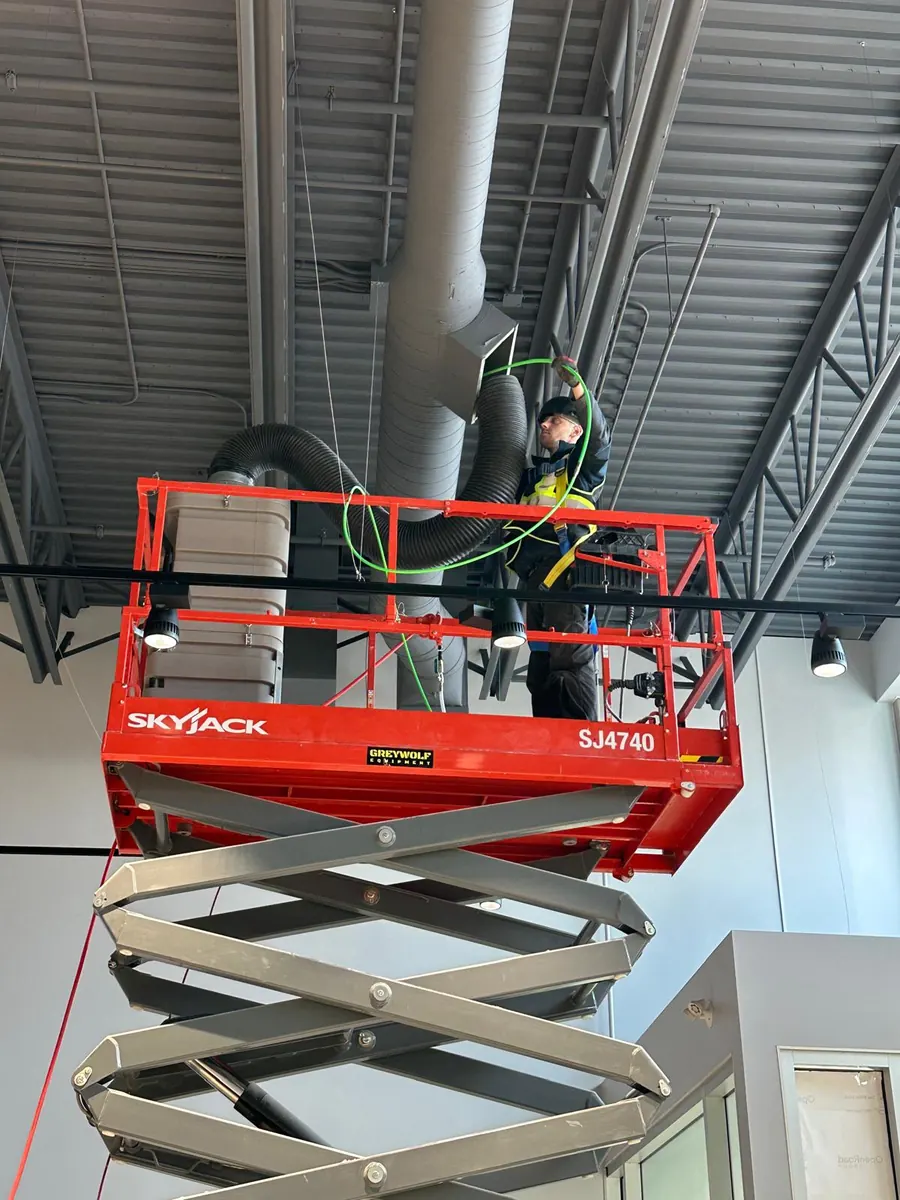
Most healthcare facilities schedule duct cleaning during off-hours: evenings, nights, or weekends when patient census is lower and elective procedures are not running. Some facilities plan major cleaning during seasonal low-census windows. The key is coordinating with your infection control team and facility management early enough that the contractor can plan crew schedules and equipment around your building’s calendar.
Zone-by-zone isolation
In a hospital with multiple air handling units, the crew can clean one zone at a time while the rest of the building stays ventilated. The section being cleaned goes on continuous negative pressure using HEPA-filtered equipment, so loosened contaminants travel toward the vacuum collection unit and away from patient areas. Adjacent zones keep operating normally.
This approach means a facility does not need a full shutdown. One wing or floor gets cleaned while the rest of the building continues to function. For facilities that cannot tolerate any downtime in critical areas, the crew works around those zones and returns to them during a scheduled maintenance window.
Containment and protection
Any work near patient areas requires containment. The crew seals off the section being cleaned. HEPA-filtered negative-air machines maintain directional airflow so that dust and debris move toward the collection point. New access openings in ductwork are closed to SMACNA and UL 181 standards: mechanically fastened, sealed, and marked on the duct exterior.
Pro tip: Walk your mechanical rooms and check AHU coils before booking a cleaning. If coil fins are matted or drain pans show residue, flag those areas for the contractor so they can allocate the right crew time and equipment for coil cleaning on top of the ductwork scope.
What the cleaning scope covers
The most effective way to clean air ducts and ventilation systems is to employ source removal methods of cleaning. In a healthcare facility, that scope typically includes the following.
Ductwork (supply, return, exhaust). HEPA-filtered negative-air vacuuming equipment connects to the system while compressed-air agitation tools work through each run to dislodge and capture dust and debris.
Air handling units. Every AHU, makeup air unit, and rooftop unit gets its accessible internal surfaces and coils cleaned using HEPA vacuuming, compressed air, and coil cleaner where appropriate. Coil fins are combed where needed. Replacement filters are supplied by the facility unless quoted separately.
Components. Diffusers, return and exhaust grilles, VAV boxes, and reheat coils are power-wiped and air-washed. Removable parts come out for air washing before reinstallation.
Coil cleaning. Heating and cooling coils are cleaned with compressed air, HEPA vacuum, and no-rinse evaporator foam to restore heat transfer and airflow.
Sanitizing (when needed). After source-removal cleaning, Benefect Decon 30 can be applied through the system with a 360-degree spray wand. It is a Health Canada approved, plant-based disinfectant used in mould remediation and restoration work, and in our hospital and clinic projects. This step reduces bacteria, mould spores, and odours throughout the ductwork.
Documentation every job delivers
Healthcare facility managers need records. Accreditation bodies ask about HVAC maintenance. Infection control teams track what has been done and when. WorkSafeBC Section 4.78 requires that preventive maintenance must be carried out on the ventilation system.
Every commercial job ends with a Certificate of Completion and a before-and-after photo report. The certificate confirms what was cleaned, the standard followed (NADCA ACR), and the date. The photo report documents duct condition before and after the work, giving your team visual proof that source removal was performed. These records go into your compliance files and are ready for the next accreditation review or maintenance audit.
Heads-up: A contractor who does not provide written documentation after the job leaves your facility without the records it needs. If an infection control audit or accreditation review asks for proof of HVAC maintenance and you have nothing on file, that gap falls on the facility.
Our healthcare experience
Our recent projects include work at Surrey Memorial Hospital, Richmond Hospital, and Kelowna General Hospital. We are NADCA certified, WorkSafeBC compliant, and carry $5M liability insurance with 10+ years of experience in commercial HVAC cleaning.
We understand the access constraints, infection control coordination, and documentation requirements that come with healthcare work. If your facility has not had its HVAC system cleaned in several years, or if your infection control team is asking about duct condition, a site walkthrough is the place to start. We assess the scope, provide a timeline, and deliver a custom quote that fits your maintenance budget.
For a broader look at commercial HVAC cleaning standards and scheduling, see our guide to commercial duct cleaning in BC. For details on air handling unit cleaning specifically, see what NADCA ACR covers for AHUs.
Where we do this work
We clean healthcare HVAC systems across BC: Vancouver, Burnaby, Surrey, Richmond, Coquitlam, Port Coquitlam, Port Moody, New Westminster, North Vancouver, West Vancouver, Delta, Langley, White Rock, Maple Ridge, Pitt Meadows, Mission, Abbotsford, Chilliwack, Squamish, Whistler, Kamloops, Kelowna, Nanaimo, and Victoria. We also serve Alberta.